
In the industrial race of 2026, efficiency is the only currency that matters. As we enter the Year of the Horse (马年), businesses are looking for the "Workhorse" of materials—something that offers the stamina to run longer and the strength to handle the heaviest loads.
When it comes to machine lining, the debate often boils down to: Hardened Steel vs. Tungsten Carbide. While steel has a lower upfront cost, a true ROI (Return on Investment) analysis reveals a different story. At Panda Carbide Technology CO., LTD., we help you move beyond the "initial price trap" to find a solution that boosts your bottom line.
1. The "Steel Trap": Why Cheap Materials Cost More
Many procurement departments choose AR500 or Manganese steel because of the lower purchase price. However, in high-abrasion environments, steel is a "false economy."
- Frequent Replacements: Steel liners may require replacement every 2–3 months.
- Labor Costs: Every replacement requires a maintenance crew, welding equipment, and safety protocols.
- Production Loss: The biggest cost isn't the plate; it’s the unscheduled downtime. If your machine isn't running, you aren't making money.
2. The Carbide Advantage: High-Performance Material Science
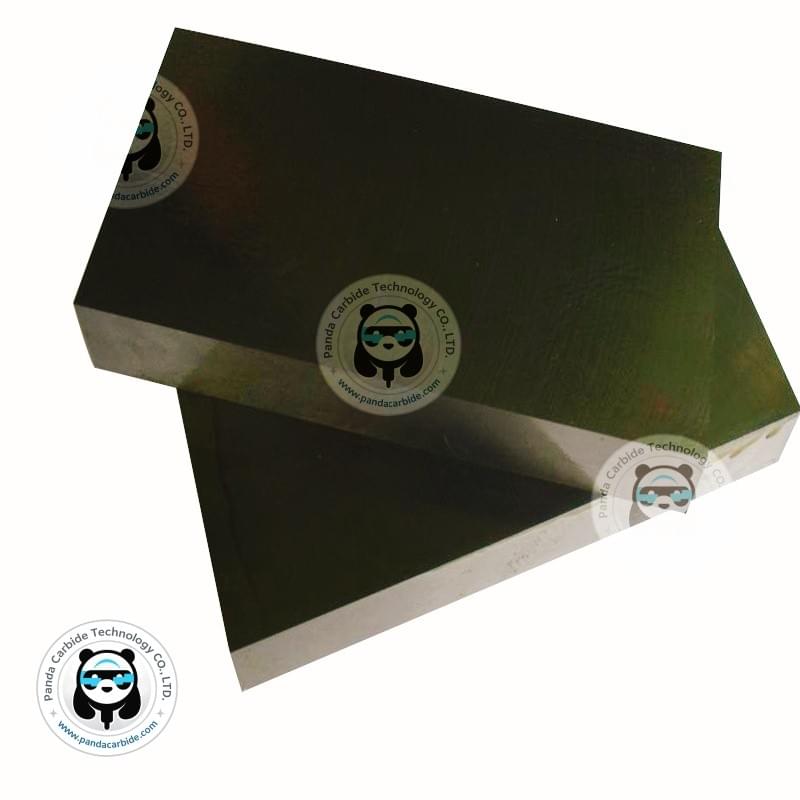
Tungsten carbide plates for machine lining are engineered for extreme durability. Using HIP (Hot Isostatic Pressing) sintering, Panda Carbide ensures every plate is 100% pore-free.
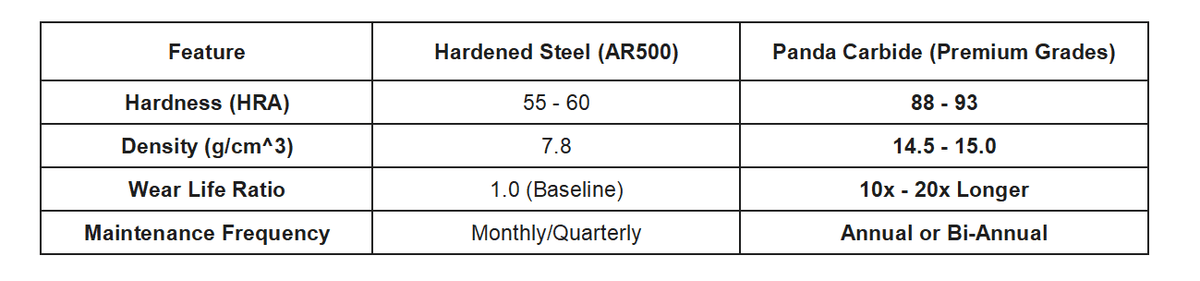
Performance Comparison Table:
3. ROI Analysis: Calculating Your Long-Term Savings
Let’s look at a typical 12-month cycle for a high-volume concrete mixer or mining chute:
- Steel Scenario: 4 replacements/year. Total cost = (Material \times 4) + (Labor \times 4) + (Down-time \times 4).
- Carbide Scenario: 1 installation/year. Total cost = (Material \times 1) + (Labor \times 1) + (Down-time \times 1).
Even with a higher initial cost, the Carbide solution typically pays for itself within the first 6 months through saved labor and increased production uptime.
For shredding applications, see how our [Carbide Shredder Inserts] provide similar ROI benefits for recycling rotors.
4. Grade Selection: Matching Cost to Application
Choosing the right grade is essential for cost-effectiveness. Buying a grade that is "too hard" for an impact-heavy environment can lead to chipping, wasting your investment.
- PD-H10 (Sub-micron Grade): Best for pure sliding abrasion (sand, fine minerals). Highest ROI for chute linings.
- PD-M30 (Medium-Coarse Grade): Best for a mix of impact and abrasion (concrete mixing, large ore). Perfect balance of price and toughness.
- Nickel-Binder Grades: Best for corrosive environments (chemical processing, wet recycling).
[Reference: Understanding Cemented Carbide Grades - ITIA]
5. Global Procurement: From China to the World
Panda Carbide supports global supply chains from our manufacturing base in China. By leveraging efficient logistics from Shanghai and Ningbo ports, we provide factory-direct pricing to:
- North America: Rapid shipping to industrial hubs in the Midwest and Texas.
- Europe: High-precision plates for German and Italian machinery OEMs.
- Australia: Heavy-duty liners for the Pilbara mining region.
6. Frequently Asked Questions | FAQs: Procurement & ROI
Q: Is tungsten carbide too brittle for high-impact machine lining?
A: Not if you choose the right grade. Panda Carbide’s HIP-sintered plates have high $TRS$ (Transverse Rupture Strength), allowing them to handle the impact of falling rocks in mining and construction.
Q: What is the lead time for custom-sized carbide plates?
A: Typically, we ship custom orders within 3–4 weeks. Compared to the frequent downtime of steel, this one-time wait provides years of stability.
🏮 2026 Vision: Galloping Toward a Profitable New Year
In the Year of the Horse, the winner of the race is the one with the most stamina. Panda Carbide plates give your machinery the endurance to outlast the competition. We wish our global partners "Ma Dao Cheng Gong" (马到成功)—may your switch to carbide bring instant success and unbridled ROI in 2026! 🐎💰
Panda Carbide - More Than Tough!