
1. Introduction
In advanced manufacturing and engineering applications, the performance of a component often hinges not just on the alloy chemistry, but how that alloy is made. For hard alloys (often in the form of cemented carbides, tungsten-carbide based materials, etc.), the manufacturing process—from powder to finished part—determines hardness, toughness, dimensional accuracy, and service life.
In this article, we walk through the key stages in hard alloy manufacturing: powder preparation, shaping/pressing, sintering, post-processing/finishing, and quality assurance. Whether you’re a procurement manager sourcing hard alloy parts or a design engineer specifying materials, this guide provides the technical insight needed to partner with a supplier or evaluate manufacturing capability.
2. Key Manufacturing Steps for Hard Alloys
2.1 Powder Preparation & Mixing
The foundation of high-performance hard alloys lies in the quality of the initial powders. For example, in a typical tungsten-carbide (WC) / cobalt (Co) “cemented carbide” system:
- Raw tungsten oxide or tungsten powder is carburised / processed to form WC.
- The WC powders are finely milled and blended with metallic binder powders (commonly cobalt, sometimes nickel or chromium) and additives (such as TiC, TaC) to tailor properties.
- Milling, spray-drying, and flowability treatment ensure a uniform and free-flowing powder mixture essential for forming.
2.2 Shaping / Pressing / Forming
Once the powder is ready, the next stage is to shape the part:
- Methods include cold pressing, isostatic pressing (CIP), extrusion, injection moulding depending on geometry and volume.
- During pressing, dimensional shrinkage due to later sintering must be anticipated—the die tooling and pressing parameters must account for this.
- The “green” compact produced after pressing is still relatively weak, and requires careful handling before sintering.
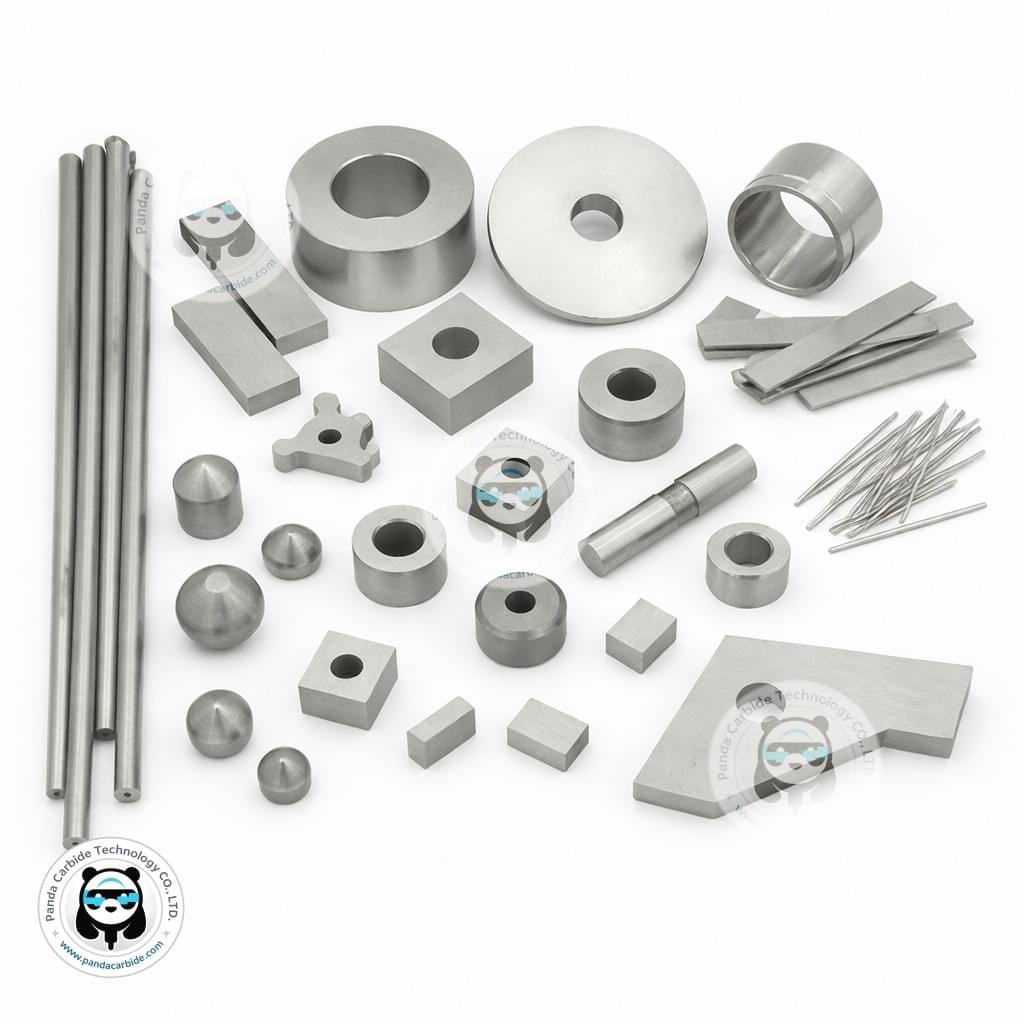
2.3 Sintering / Densification
Sintering is the heart of hard alloy consolidation:
- During sintering, the green compact is heated (often near or above the binder’s melting point) so that liquid phase bonding occurs between carbide particles and the binder.
- For tungsten carbide cemented alloys, typical temperatures range from ~1300 °C to 1500 °C, depending on composition and processing method.
- Sintering variables (temperature, time, atmosphere, pressure) influence final density, microstructure, grain growth, and binder distribution—all of which affect hardness, toughness and wear resistance.
- Some processes include hot isostatic pressing (HIP) after sintering to further reduce porosity and improve mechanical properties.
2.4 Post-Processing & Finishing
After sintering, the parts still require finishing to meet tight dimensional, surface and performance specifications:
- Grinding, EDM (electrical discharge machining), CNC machining or laser cutting to achieve final geometry and tolerances.
- Where enhanced wear or oxidation resistance is required, surface coatings (PVD, CVD, diamond/CBN overlays) may be applied. For example, applying a diamond coating to a WC-Co substrate reduced wear and improved performance.
- Final inspection, marking, packaging and shipment.
2.5 Quality Assurance & Microstructure Control
Manufacturing quality is decisive. Key quality-control aspects include:
- Microstructure analysis (carbide grain size, binder content, porosity) — a high density, fine and uniform microstructure improves wear resistance and strength.
- Chemical composition confirmation: verifying carbide/binder ratios, impurity levels, binder phase continuity.
- Mechanical testing: hardness, bending strength, fracture toughness, wear testing.
- Traceability: batch records, process parameters, certifications.
Accurate QA ensures that the manufacturing route actually delivers the expected performance.
3. Why Manufacturing Matters for Buyers
Understanding the manufacturing process of hard alloys is not an academic exercise — for a buyer or engineer specifying components, awareness of process stages influences performance, cost and risk.
- Material consistency: A component that looks identical but comes from poor powder preparation or uneven sintering may fail prematurely.
- Cost drivers: Processes like HIP, precision grinding, coatings add cost — knowing which process you’re paying for helps in negotiation.
- Lead time implications: Pressing tooling, sintering cycles, finishing steps define production timeline — relevant for urgent orders or prototypes.
- Custom geometry feasibility: Complex shapes require moulds, injection or special processing; discussing this early with your supplier avoids surprises.
- Performance assurance: If your application involves extreme wear / temperature / precision, you’ll want a supplier who can demonstrate their manufacturing process, microstructure data, and final inspection reports.
4. Best Practices & Buyer Checklist
For procurement managers, materials engineers and reliability teams selecting hard alloy suppliers, here’s a practical checklist:
- Request detailed process specifications: powder chemistry, binder type, carbide particle size, sintering schedule.
- Visit or audit the manufacturing line (if possible): observe powder handling, press tooling, furnace capacity, finishing machines.
- Ask for microstructure records or SEM images: confirm uniform carbide-binder distribution, minimal porosity, correct binder wetting.
- Evaluate finishing capability: Does the supplier offer precision grinding, coatings, QA documentation?
- Ensure traceability: batch ID, process records, test certificates.
- Confirm delivery lead-time: pressing lead-time, sintering cycles, finishing backlog, setup time for custom geometries.
- Understand cost structure: which process steps are standard, which are premium; this helps you compare quotes apples-to-apples.
- Plan for maintenance & repair options: modular inserts, replaceable wear parts, spare inventory for critical components.
- Align on performance guarantees: wear life, service temperature, tolerances, inspection data.
- Maintain supplier relationship: early collaboration on prototypes, incremental batches, process improvement feedback.
5. How Panda Carbide Supports Your Hard Alloy Needs
At Panda Carbide, we bring full-process capability and support for custom hard alloy manufacturing:
- In-house powder formulation, mixing and quality control to ensure consistency from raw material to finished product.
- Pressing and sintering capacity tailored for complex geometries and small to mid-volume production runs.
- Precision finishing: grinding, EDM, coating services offered to meet high-tolerance components.
- Comprehensive QA: microstructure analysis, test reports (hardness, bending, micrograph), traceable batch documentation.
- Rapid sample prototyping, small-batch manufacturing, and technical consultation for material/process optimization.
- Strategic support for high-wear, high-temperature applications: we help specify the right grade, processing route, and finishing strategy to meet your service demands.
By partnering with a supplier who understands manufacturing not just “the material” but “how it is made”, you reduce risk, ensure performance and drive value.
6. Summary
Hard alloy manufacturing—especially cemented carbides and similar composites—is a sophisticated process involving powder metallurgy, pressing, sintering, finishing and rigorous QA. For buyers of hard alloy components, knowledge of this process is not optional — it is a critical factor in selecting the right supplier, avoiding hidden risks and optimizing cost-performance.
If you’re looking for hard alloy parts with reliable performance, custom geometry, and full manufacturing transparency — contact Pandacarbide. We’re ready to walk you through our process, show you manufacturing data, and help you match the perfect hard alloy solution for your application.
Panda Carbide - More Than Tough!