

Premium Tungsten Carbide Crosscutting Knives | Rotary Sheeter Blades for Paper Converting
$37.98
Eliminate jagged edges, high-velocity dust accumulation, and costly blade adjustments with Panda Carbide's Inlaid & Solid Tungsten Carbide Crosscutting Knives (Paper Sheeter Blades). Specially engineered for heavy-duty rotary sheeters, cut-size sheeters, and folio sheeting lines, these straight shearing blades deliver a surgical, dust-free separation path on highly abrasive paper, cardboard, and composite webs.
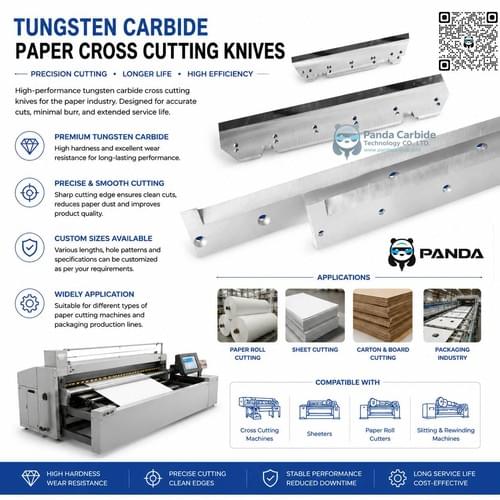
Our crosscut knives feature a state-of-the-art Bi-Metal Inlaid Structure (as shown in our product line gallery), permanently bonding a super-hard, virgin tungsten carbide cutting edge to a high-toughness, shock-absorbing tool steel backing. This advanced metallurgy gives you the ultra-wear resistance of carbide combined with the structural resilience needed to absorb heavy dynamic impact.
⚠️ Core Unique Selling Proposition (USP): Advanced Inlaid Brazing & Zero-Defect Bonding
In high-speed rotary crosscutting, standard tool steel blades dull in days, while poorly manufactured inlaid blades are highly vulnerable to delamination (carbide peeling off the steel backing) or edge chipping when hitting thick multi-layer materials.
Panda Carbide completely resolves these failure modes:
Proprietary High-Strength Tri-Metal Brazing: We utilize premium silver-based alloy brazing foils and localized, temperature-controlled induction heating to secure an unbreakable atomic bond between the tungsten carbide tip and the steel backing. This ensures zero delamination even under continuous 24/7 cyclical shearing impact.
Overpressure HIP Sintered Carbide: Our virgin sub-micron tungsten carbide inserts undergo Hot Isostatic Pressing (HIP) Sintering at TRS ≥ 2800 MPa. This maximizes toughness and ensures that the keen cutting bevel maintains its structural integrity without micro-chipping.
Advanced Stress Relieving: Post-brazing, all blades go through a thermal stress-relief cycle to prevent micro-warping and ensure absolute flatness across long dimensions ( up to 3200 mm ).
1. Technical Specifications & Mechanical Tolerances
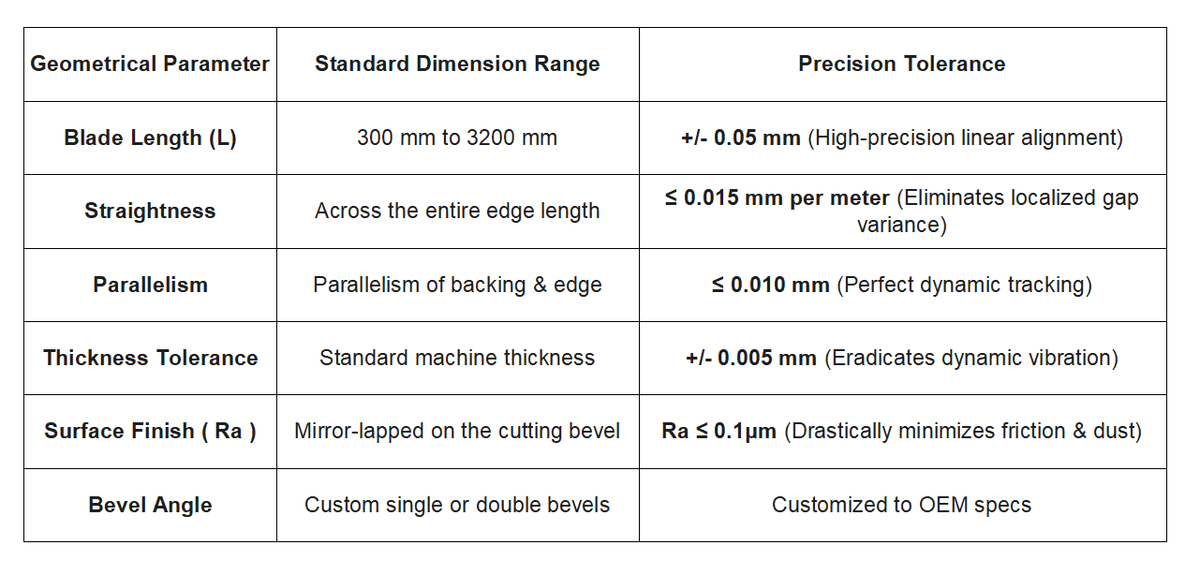
To ensure smooth rotation, minimize knife-head vibration, and prevent premature bearing wear, our sheeter blades are ground on precision CNC linear grinders to strict tolerances:
Note: Integrated mounting slots, threaded countersinks, oil ports, and customized positioning notches (as displayed in the product photos) are precisely machined to fit your specific rotary cutter cylinder.
2. Strategic Application Scenarios & Substrate Compatibility
Panda Carbide’s crosscut knives are engineered to process high-abrasivity, high-density, or delicate web matrices across global converting operations:
Paper Mills & Folio Sheeting: Precision sheeting of offset paper, high-gloss coated art paper, kraft paper, linerboard, and high-density liquid packaging board.
Cut-Size Sheeting Lines: Continuous, ultra-high-speed sheeting of standard A3/A4 office copier paper with zero structural edge curling.
Heavy-Duty Packaging & Board Mills: Straight, clean sheeting of multi-wall corrugated board, greyboard, solid fiberboard, and composite laminates without crushing the core structures.
3. Advanced Technical Solutions & Engineering Guidelines
Q: Why are inlaid tungsten carbide sheeter knives significantly more cost-effective than standard high-speed steel (HSS) blades in rotary cutters?
A: Modern papers contain up to 30 % mineral fillers (like kaolin clay, calcium carbonate, and titanium dioxide) which act as severe abrasives on metal cutting edges. Standard HSS blades wear out rapidly, requiring frequent shutdown intervals for blade regrinding.
Panda Carbide's inlaid tungsten carbide knives possess an unyielding micro-hardness of HRA 89.0 - 91.5. This enables them to outlast standard HSS knives by 10 to 15 times. By minimizing sheeter downtime, eliminating paper edge burrs, and keeping dust out of optical slitting sensors, our carbide blades lower your total converting cost per ton by up to $40\%$.
Q: How does Panda Carbide prevent blade warping and guarantee straightness across blades over 2 meters in length?
A: The primary challenge of manufacturing long, inlaid sheeter blades is managing the mismatch in thermal expansion coefficients between tungsten carbide and backing steel. If cooled too rapidly after brazing, the blade will warp. At Panda Carbide, we utilize programmable slow-cooling thermal chambers followed by rigorous hydraulic tension-leveling and multi-axis CNC surface grinding. This stress-relief protocol ensures our long blades hold a straightness of ≤ 0.015 mm per meter, ensuring a perfectly uniform shearing gap from the drive side to the operator side.
4. Global Machinery Integration & Supply Chain Reliability
Our custom-engineered sheeter knives are designed to serve as direct-drop replacement components for leading global sheeter OEMs, including:
MarquipWardUnited / BW Papersystems
Bielomatik / Will-Pemco
Jagenberg / Pasaban / Maxson
Valmet / Metso
Complete Confidentiality & Blueprint Security: We manage all custom 2D/3D technical drawings (DWG, STEP, DXF) under strict corporate Non-Disclosure Agreements (NDA), ensuring your proprietary equipment specs remain 100 % confidential.
📩 Contact us today for bulk wholesale inquiries or custom requests.
https://www.pandacarbide.com/contact-us