
In high-volume paper conversion lines—spanning continuous industrial tissue wrapping, multi-ply spiral core winding, and heavy-duty corrugated board manufacturing—the rotary cutting station is the primary catalyst for operational efficiency. Unlike standard polymer slitting, high-speed paper conversion deals with highly abrasive cellulose fibers and embedded mineral fillers like calcium carbonate. When processing these substrates at scale, standard tool steel cutters dull and overheat, resulting in severe edge scorching, crushed core diameters, and excessive airborne paper dust.
To secure maximum machinery runtime, global packaging groups are upgrading to Tungsten Carbide Slitting Saws and Tooth-Edged Milling Cutters. However, because these tools feature a large internal bore and a relatively thin body profile to fit multi-groove machine hubs, lower-grade carbide often suffers from dynamic runout or catastrophic tooth tipping. At Panda Carbide Technology, we eliminate these operational risks through 100% virgin powder metallurgy and micron-level automated grinding, supplying solid hardmetal slitting saws that outlast traditional blades under heavy shock loads.
1. Preventing Tooth Tipping: Overpressure HIP Sintering Dynamics
Why do Panda Carbide’s tooth-edged slitting saws resist edge micro-chipping better than conventional circular cutters under high-velocity cyclic loading?
The edge retention of our industrial rotary saws is driven by two main technological factors:
Elimination of Recycled Scrap: We enforce a strict $100\%$ virgin raw material protocol. Recycled scrap carbide contains inconsistent trace elements that create microscopic cleavage lines, which cause sharp tooth peaks to snap off under impact. Our uniform sub-micron grain structures maintain cohesive chemical bonds under intense pressure.
Overpressure HIP Consolidation: During the critical liquid phase of sintering, our preforms are subjected to high-pressure hot isostatic pressing. This flushes out all remaining microscopic internal voids, raising the material's Transverse Rupture Strength (TRS ≥ 2900 MPa ). This uniform grain density allows each tooth to act as a resilient shock absorber, resisting cracking even during interrupted cuts through heavy-walled shipping cores.
2. Eradicating Dynamic Axial Runout in Large-Bore Systems
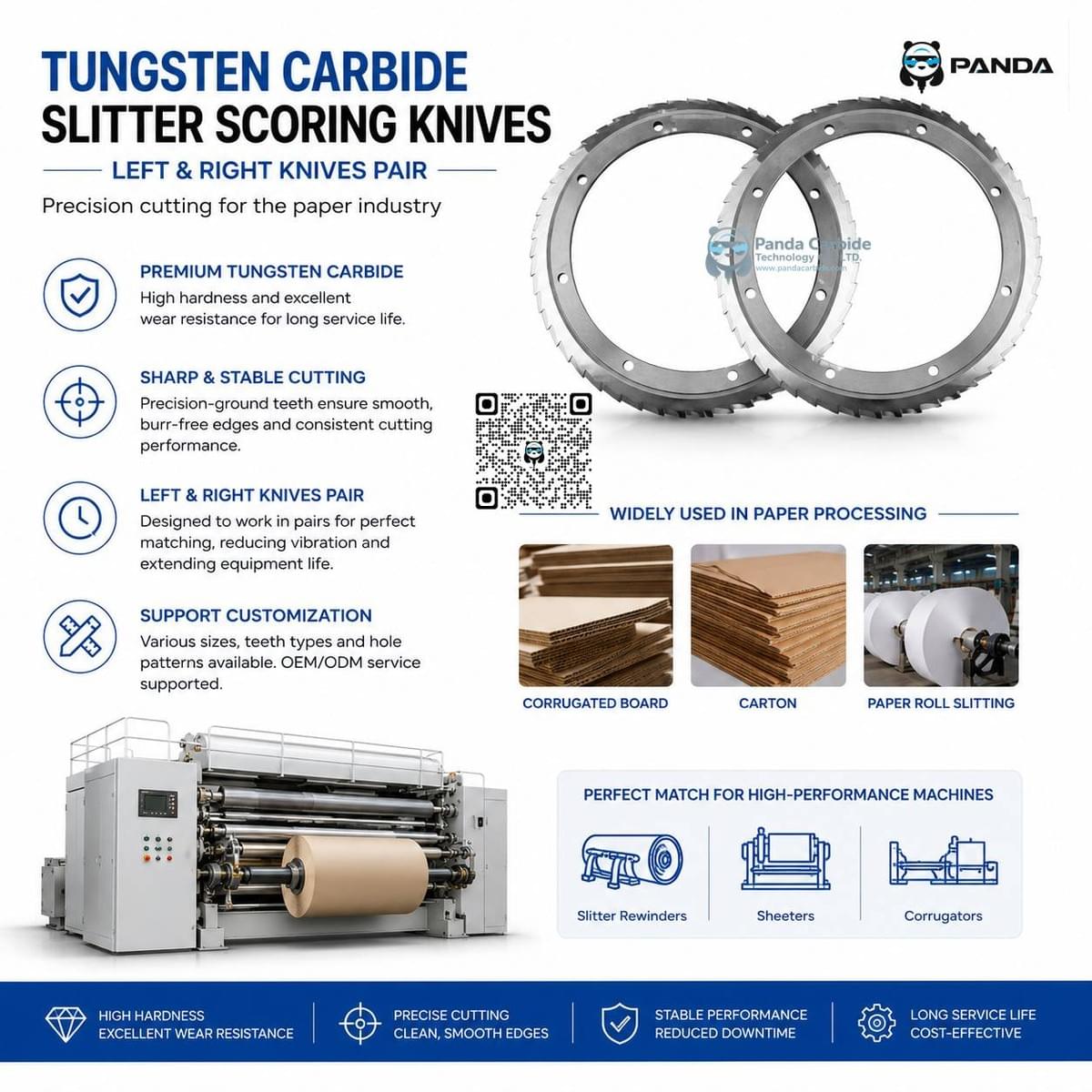
As shown in our production schematics, these specialized slitting saws feature a prominent large internal bore with integrated drive pinholes. This mechanical architecture delivers a positive, non-slip lock onto automated machine shafts, eliminating keyway wear and frictional slippage during sudden accelerations.
However, grinding a large-bore, thin-profile hardmetal disc requires precise thermal control. If localized grinding heat spikes, internal stresses distort the blade, leading to dynamic runout.
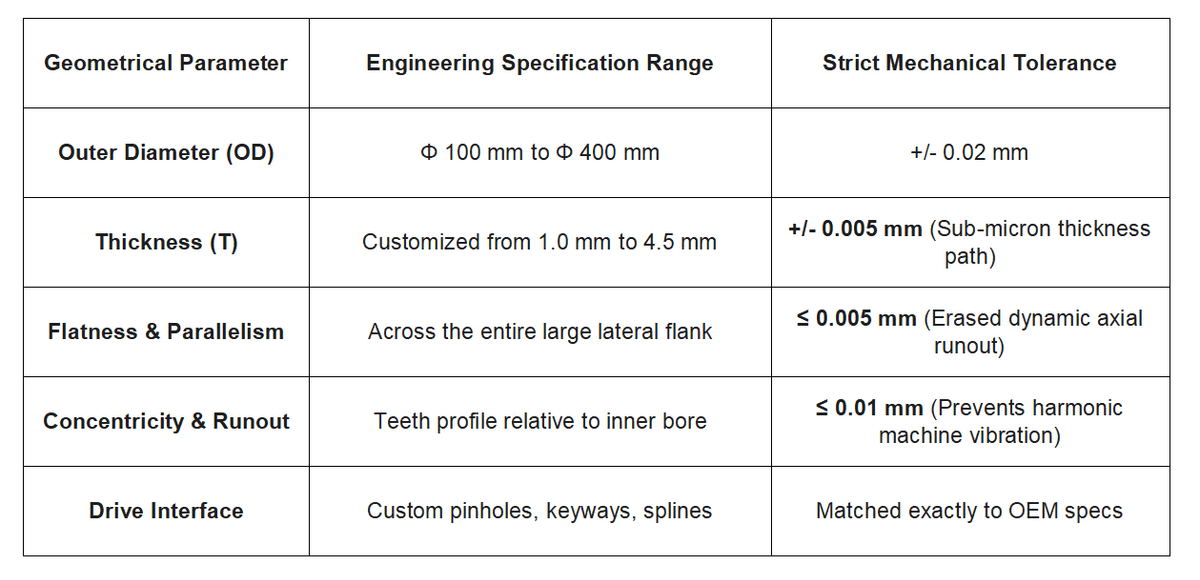
Panda Carbide resolves this through automated, multi-axis CNC grinding systems equipped with constant, refrigerated synthetic oil coolants. This process holds strict geometric tolerances across global production arrays:
- Flatness & Parallelism: Maintained at an exceptional ≤ 0.005 mm, preventing high-speed lateral weaving that widens the kerf channel.
- Concentricity: Controlled to ≤ 0.01 mm relative to the inner bore, mitigating high-frequency harmonic vibrations that cause premature spindle bearing wear.
3. Technical FAQ: Multi-Tooth Shearing vs. Toothless Slitting
Q: In what manufacturing scenarios is a tooth-edged carbide slitting saw superior to a smooth-edged circular blade?
A: When dividing dense multi-ply tissues, thick cardboard, or tightly wound core bodies, a toothless circular blade relies entirely on friction compression to shear the material. This continuous contact generates severe friction heat, which melts structural adhesives, causes gumming, and produces ragged, scorched roll edges.
Panda Carbide’s Tooth-Edged Milling Cutters reduce tool-to-substrate friction. The individual, micro-ground teeth serve as effective chip-breaking pockets that clear away loose micro-fibers and adhesive residue. Concentrating the structural cutting force on sharp tooth peaks allows the machinery to run up to 30°C cooler, drawing less energy while reducing airborne paper dust by up to 85 % .
4. Cross-Industry Tooling Synergy and Global Supply Chain Integration
Our large-bore sintering expertise, micron-level flatness controls, and micro-ground tooth geometries also drive our full portfolio of high-wear industrial and converting components:
- Internal Link: For finishing lines utilizing thin-profile, continuous shear cutting configurations, explore our mirror-finished [Ultra-Thin Tungsten Carbide Slitting Circular Knives].
- Internal Link: For heavy-duty packaging hubs managing automated web-slitting shafts, view our high-sync [Rewinder Slitting Knives & Bottom Anvil Blades].
- External Link: [Consult the mechanical maintenance standards published by the Technical Association of the Pulp and Paper Industry (TAPPI) regarding optimal dust containment and knife alignment in high-speed tissue converting systems.]
🏆 Maximize Conversion Performance with Panda Carbide Technology
Fortify your high-frequency conversion lines with industrial tooling engineered for endurance and micron-level precision. By pairing premium virgin metallurgy with overpressure HIP sintering and advanced CNC cooling controls, Panda Carbide Technology supplies slitting saws that eliminate edge defects and maximize your plant's operational efficiency.
📩 Contact our B2B engineering desk today to submit your mechanical drawings and tooth profile requirements for a rapid quote!
Panda Carbide - More Than Tough!
Industrial Slitting Saws Specialist | Panda Carbide Technology CO., LTD.