
In modern automotive, aerospace, and heavy fastener manufacturing, cold extrusion and cold heading have largely replaced traditional chip-removal machining. The reason is clear: cold forming offers superior grain flow, higher component fatigue strength, and zero material waste.
However, cold-extruding complex geometries—such as internal spline sleeves, drive shaft joints, Torx fasteners, and high-precision gears—subjects forming dies to extreme physical stress. Forming pressures routinely exceed 1,500 to 2,000 MPa, leading to rapid die fatigue, internal spline radial expansion, surface galling, and premature cracking.
To combat these extreme mechanical forces, Panda Carbide Technology CO., LTD. has developed specialized Sub-Micron Tungsten Carbide Internal Spline Extrusion Dies and Cold Heading Sleeves. This article explores the metallurgy, precision machining, and grade selection criteria required to extend cold forming tool life by over 300%.
1. Physical Failure Modes in Cold Extrusion Dies
Understanding why standard tool steels (such as AISI H13, D2, or M2) fail during internal spline forming is the first step toward process optimization:
- Radial Plastic Deformation & Bore Enlargement: High radial forces push tool steel beyond its yield strength, causing the internal spline profile to expand beyond acceptable tolerances ( +/- 0.005 mm ).
- Adhesive Wear & Surface Galling: High-pressure friction between the steel workpiece and the steel die causes micro-welding, resulting in severe surface scoring and workpiece pickup.
- Catastrophic Hoop Stress Splitting: The internal sharp corners of star-drive or multi-spline geometries act as severe stress concentrators. Under cyclic impact loading, micro-cracks propagate, leading to sudden longitudinal die failure.
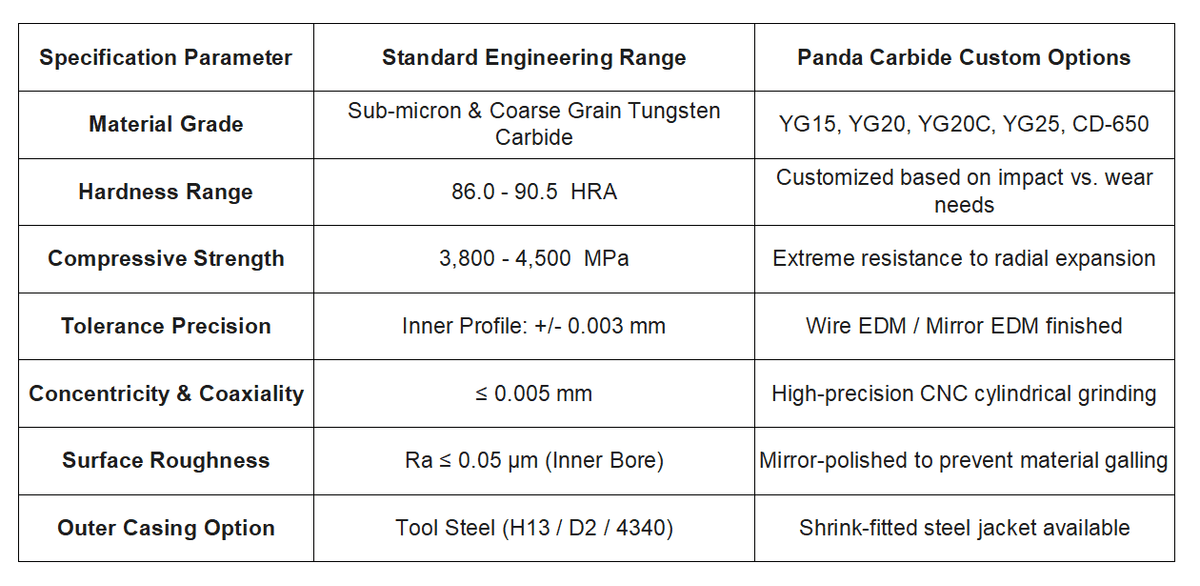
By replacing steel cores with advanced Tungsten Carbide Forming Inserts, manufacturers achieve up to 10 times higher compressive strength ( 3,800 - 4,500 MPa ), effectively eliminating elastic deformation during peak forming strokes.

2. Advanced Metallurgy: Overpressure HIP Sintering & Grain Structure
Not all carbide dies are created equal. The mechanical performance of an internal spline die depends entirely on powder purity, grain size distribution, and sintering density.
100% Virgin Raw Materials: Panda Carbide Technology CO., LTD. strictly avoids recycled scrap powder. Pure tungsten and Cobalt powders ensure consistent fracture toughness ( K_{IC} ) across the entire die cross-section.
Overpressure Hot Isostatic Pressing (HIP): Sintering at 1,450 °C under high-pressure Argon gas eliminates internal micro-voids, achieving an A00 porosity rating according to ISO 4499. Eliminating micro-voids prevents stress concentration points where fatigue cracks typically initiate.
Optimized Cobalt Binder Distribution: For high-impact cold heading, a coarse-grain matrix with 15 % - 25 % Cobalt (such as Grade YG20C or YG25) provides maximum shock absorption. For high-wear powder metallurgy compaction, sub-micron grades (YG15 or CD-650) offer hardness levels reaching 89.5 - 91.0 HRA .
3. Precision Manufacturing: Wire EDM & Mirror Polish Finish
Machining complex internal spline profiles inside ultra-hard tungsten carbide requires state-of-the-art CNC grinding and EDM technologies:
- Sub-Micron Wire EDM Profile Machining: High-precision CNC wire-cut EDM creates exact internal spline teeth, involute profiles, and keyways with tolerances within +/- 0.003 mm .
- Elimination of the White Layer (Recast Layer): Improper EDM spark erosion leaves a brittle, tension-stressed "recast layer" on the carbide surface. Panda Carbide utilizes multi-pass fine EDM finishing followed by chemical etching to remove this layer, eliminating micro-crack initiation sites.
- Mirror Inner Bore Polishing ( Ra ≤ 0.05 μm ): Internal flow channels and spline flanks are polished to a mirror finish. This drastically reduces the friction coefficient during cold metal displacement, preventing material adhesion and ensuring smooth component ejection.
- Pre-Stressed Steel Outer Casing (Shrink Fitting): To counteract tensile hoop stresses during extrusion, carbide die cores are shrink-fitted into heavy-duty tool steel jackets (such as AISI 4340 or H13). This puts the carbide core under compressive pre-stress, doubling its fatigue limit under cyclic loading.
4. Grade Selection Matrix for Cold Forming Applications
Selecting the correct carbide grade is critical to balancing wear resistance against impact toughness:

5. Technical FAQ for Engineers
Q: Why do tungsten carbide internal spline dies require shrink-fitting into steel outer sleeves?
A: Tungsten carbide possesses ultra-high compressive strength (>4,000 MPa) but lower tensile strength compared to steel. During cold extrusion, internal radial pressures generate severe outward tensile hoop stress. By shrink-fitting the carbide die core into a pre-stressed alloy steel jacket (e.g., H13 or AISI 4340), the steel jacket exerts an inward compressive force on the carbide. This pre-stress counteracts radial tension during forming strokes, preventing longitudinal die splitting.
Q: How does switching from tool steel to Panda Carbide spline dies impact cold forming unit production costs?
A: While initial tooling cost for tungsten carbide is higher than tool steel, carbide dies typically deliver a 5X to 10X increase in total stroke life (often exceeding 100,000 - 300,000 operations). This drastically reduces press downtime, lowers tool change frequency, minimizes part inspection rejects, and eliminates workpiece surface re-machining, resulting in a 30 % - 50 % reduction in net per-part tooling cost.
6. Partner with Panda Carbide Technology CO., LTD.
Engineered for extreme wear resistance, tight tolerance retention, and maximum shock resistance, Panda Carbide Technology CO., LTD. is your trusted global OEM partner for custom tungsten carbide cold forming tools, internal spline dies, and powder compacting sleeves.
- Custom OEM Fabrication: Machined strictly to your engineering CAD drawings (.DWG / .STEP / .IGS).
- Global Delivery & Technical Support: Exporting premium carbide components to Tier-1 automotive suppliers, fastener manufacturers, and machine tool builders across North America, Europe, Southeast Asia, and Eastern Europe.
📩 Ready to upgrade your cold extrusion tool life?
Submit your CAD specifications and forming requirements to our engineering team today for a fast quote and technical evaluation!
Website Store: www.pandacarbide.com/store/
Contact Engineering: info@pandacarbide.com
Industry Standards Reference: ISO 4499 Hardmetals Microstructure Specification | MPIF Standard 35 for Powder Metallurgy
Panda Carbide - More Than Tough!