
Target Keywords: Tungsten carbide extrusion dies, flat copper wire drawing dies, carbide shaped wire drawing dies, EV hairpin motor wire extrusion dies, continuous extrusion dies, carbide cold drawing tooling, anti-galling wire drawing dies.
In modern high-efficiency electrical equipment manufacturing—spanning EV hairpin drive motors, power transformers, renewable energy photovoltaics, and high-voltage magnet wire—the demand for high-purity Oxygen-Free Copper (OFC) and aluminum flat wires has expanded rapidly.
During high-speed continuous extrusion (Conform process) and multi-pass cold drawing, passing metal through flat or rectangular die channels subjects carbide tooling to severe operational loads:
- Copper Galling & Surface Pickup: Microscopic metal particles fuse onto the carbide bearing land under extreme thermal friction, causing severe longitudinal scratches on the wire surface.
- Internal Hoop Tensile Failure: Continuous hydraulic pressures exceeding 1000 MPa cause unreinforced carbide inserts to develop radial micro-cracks.
- Dimensional Drift & Corner Radius Wear: Rapid wear at the flat wire corner radius ( R ) leads to uneven enamel coating thickness, risking electrical insulation breakdown.
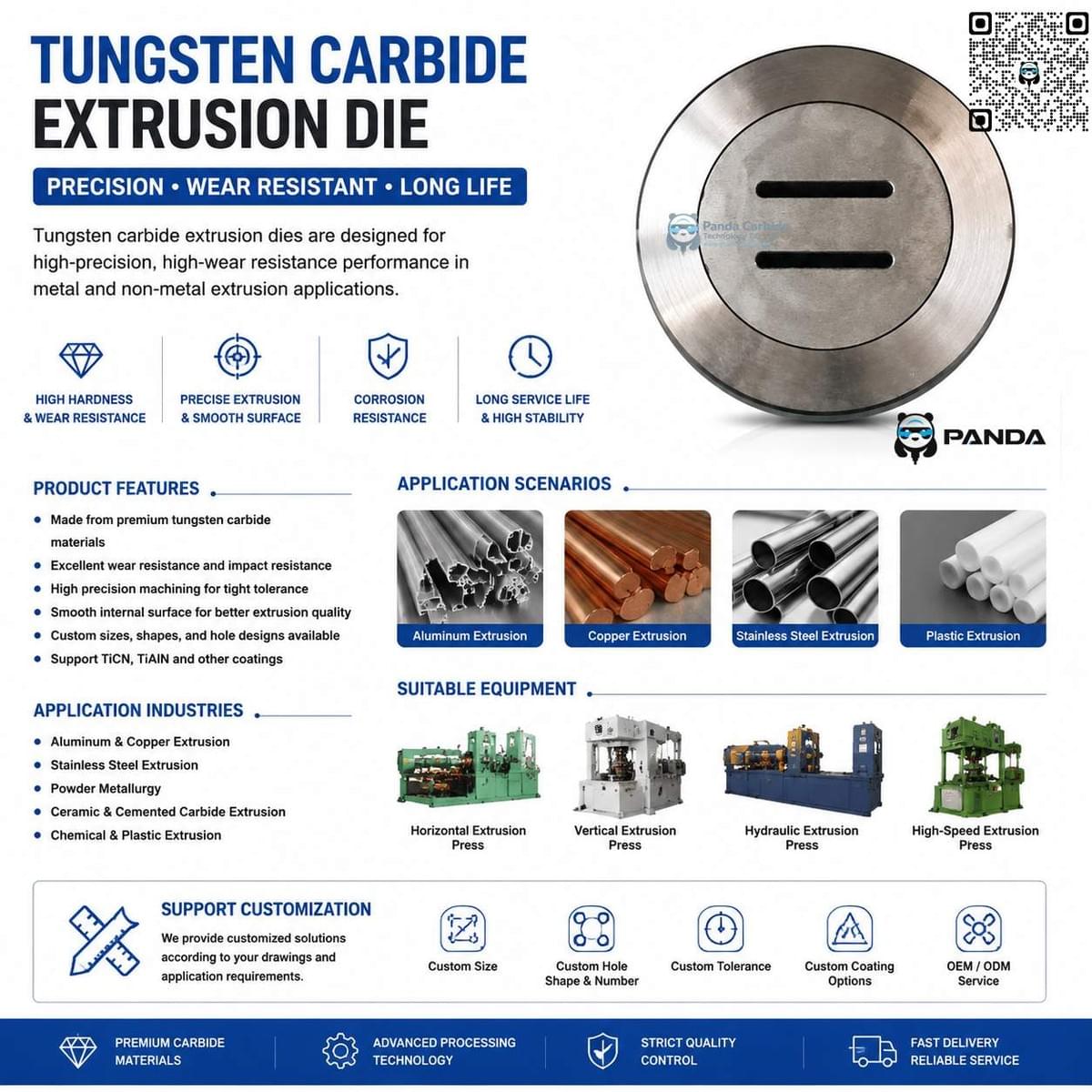
To solve these wire forming bottlenecks, Panda Carbide Technology CO., LTD. engineers Precision Tungsten Carbide Extrusion & Wire Drawing Dies built specifically for flat and complex shaped profiles.
1. The Mechanics of Anti-Galling: Sub-Micron Diamond Lapping
How do Panda Carbide’s flat wire drawing dies eliminate copper pickup and lower drawing forces during high-speed cold drawing?
Metal galling is triggered when localized friction heat causes soft copper micro-particles to weld into surface microscopic valleys on the carbide bearing land.
Panda Carbide eliminates material adhesion through three engineering steps:
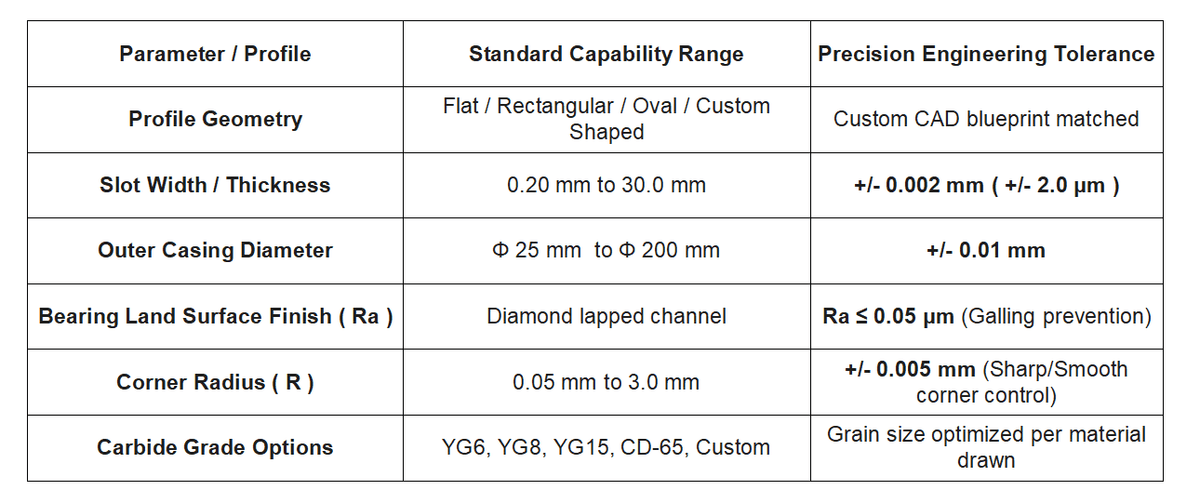
- Sub-Micron Mirror Lapping ( Ra ≤ 0.05 μm ): Die channels and bearing lands are polished using sub-micron diamond paste, eliminating microscopic surface valleys where soft copper can collect and weld.
- Optimized Entrance & Relief Geometry ( 12 ° - 16 ° Approach Angles): Custom approach angles allow liquid drawing lubricants or MQL oil mist to form a continuous hydrodynamic film, dramatically lowering pulling tension.
- HIP-Sintered Micrograin Substrates (YG6 / YG8 / CD-65): Overpressure Hot Isostatic Pressing (HIP) removes internal micro-voids, delivering a dense matrix that withstands high mechanical stress without binder degradation.
2. Pre-Stressed Structural Enclosures: Neutralizing Hoop Tensile Stress
Tungsten carbide possesses exceptional compressive strength ( >4000 MPa ) but lower tensile strength. During continuous extrusion (Conform process), internal radial forces attempt to push the carbide nib outward, creating destructive hoop tensile stresses.
Panda Carbide enforces rigorous pre-stress engineering across all die casings:
- Thermal Interference Shrink-Fitting: The carbide nib insert is thermal-shrink-fitted into a heavy-duty alloy steel casing (e.g., H13 / 42 CrMo ).
- Dynamic Pre-Stress Neutralization: As the outer steel casing cools and contracts, it imparts a uniform inward compressive pre-stress on the carbide nib. This pre-stress neutralizes internal radial expansion forces during operation, extending die fatigue life by up to 300 % .
3. Technical FAQ: EV Hairpin Motor Wires vs. Magnet Wire Dies
Q: Why do EV hairpin motor wire dies require strict corner radius ( R ) tolerances and zero corner wear?
A: In EV hairpin stator winding, flat copper wire must fit tightly into stator slots to maximize copper slot-fill factor. If the wire drawing die experiences corner wear, the flat wire's corner radius ($R$) expands inconsistently. During subsequent insulation coating (PAI/PEEK) and hairpin bending, uneven enamel thickness at the corners creates dielectric weak points, risking short circuits in electric vehicle powertrains. Panda Carbide maintains corner radius tolerances down to +/- 0.005 mm, ensuring uniform insulation coverage.
4. Cross-Industry Tooling Synergy & Global Supply Chain Integration
Our sub-micron grinding capabilities, thermal pre-stressing expertise, and ultra-dense carbide metallurgy drive our complete line of industrial tooling:
- Internal Link: For precision CNC metal removal and high-RPM milling, explore our [Rainbow PVD Nano-Coated Solid Tungsten Carbide End Mills].
- Internal Link: For zero-burr battery current collector foil converting, view our ultra-precision [Tungsten Carbide Circular Slitting Knives for Battery Electrodes].
- External Link: [Consult the technical guidelines for electrical copper wire dimensions and enamelled rectangular wire tolerances published by the International Electrotechnical Commission (IEC 60317 series).]
🏆 Partner with Panda Carbide Technology CO., LTD.
Secure your flat copper wire drawing and continuous extrusion lines with dies engineered for extreme pressure, mirror-smooth finishes, and anti-galling performance. By combining 100 % virgin powder metallurgy with interference shrink-fit steel casings and optical diamond lapping, Panda Carbide Technology CO., LTD. delivers the tooling reliability demanded by global wire manufacturers.
📩 Submit your CAD technical blueprints (STEP, DWG, DXF) to our B2B engineering team today for a rapid, secure quote!
Panda Carbide - More Than Tough!
Wire Drawing & Extrusion Tooling Specialist | Panda Carbide Technology CO., LTD.