
In modern lithium-ion battery manufacturing—spanning high-capacity EV power cells, energy storage systems (ESS), and high-energy 3C digital batteries—the continuous longitudinal electrode slitting station is a critical quality control gate. Sheering thin current collector foils ( 10 μm - 15 μm aluminum for cathodes and 4.5 μm - 8 μm copper for anodes) coated with brittle active slurries (LFP, NMC, or synthetic graphite) places extreme mechanical demands on rotary slitting knives.
Even microscopic edge anomalies can lead to catastrophic cell failures:
- Micro-Burrs exceeding 10 μm can puncture the polyolefin separator film during cell winding or stacking, causing internal short circuits and thermal runaway risks.
- Cold Welding (Gall / Material Adhesion) occurs when soft copper or aluminum micro-particles fuse onto the cutting land under friction heat, ruining edge straightness and causing slurry flaking.
To secure zero-defect safety standards and maximize line uptime, global battery Gigafactories are replacing standard tooling with Panda Carbide's Ultra-Precision Tungsten Carbide Circular Slitting Knives.
1. The Physics of Anti-Cold Welding: DLC Coatings & Precision Land Grinding
How do Panda Carbide’s precision electrode slitting knives eliminate copper/aluminum cold welding during continuous high-speed shearing?
The adhesion of soft metal foils onto cutting edges is driven by localized friction heat and high normal contact pressure.
Panda Carbide completely resolves cold welding through a three-layer engineering defense:
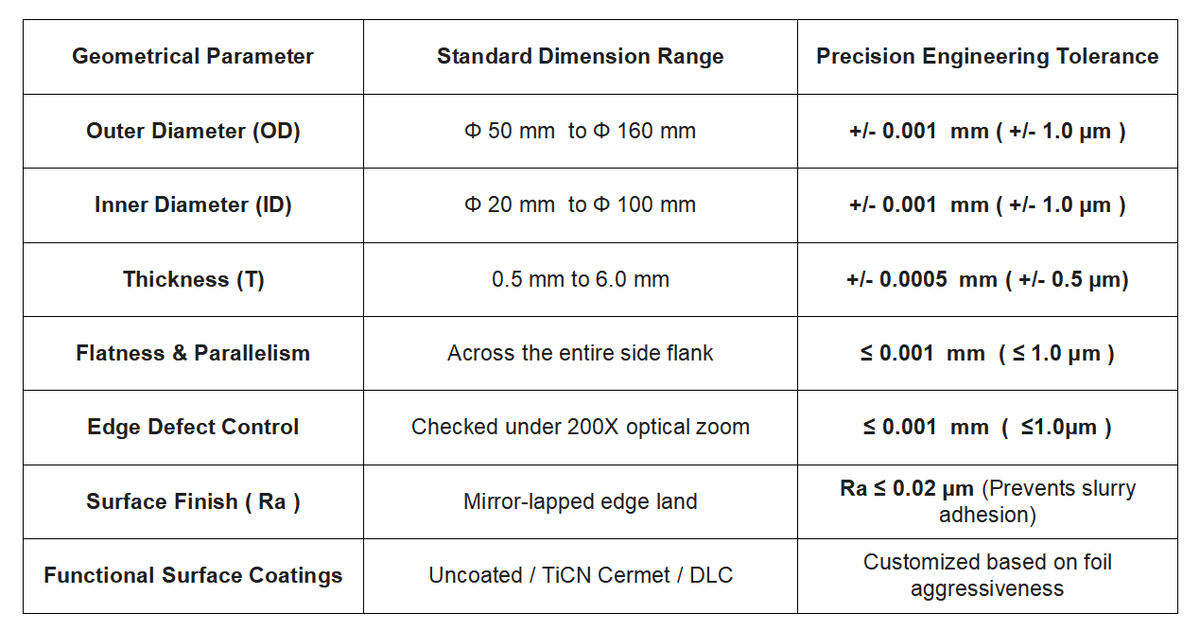
- Sub-Micron Mirror-Lapped Bevels: The cutting edge lands are lapped to an exceptional finish of Ra ≤ 0.02 μm . This ultra-smooth topography eliminates surface microscopic valleys where soft foil particles normally collect and fuse.
- Functional DLC (Diamond-Like Carbon) Thin Films: We apply an optional amorphous carbon film providing a very low friction coefficient ( μ ≤ 0.1 ) and extreme surface hardness ( ≥ 3000 HV ). This chemically inert barrier prevents direct metal-to-metal bonding between the blade and the foil substrate, completely eradicating cold welding.
- Overpressure HIP Sintered Substrate: Our high-density tungsten matrix resists wear from hard LFP slurry particles, extending tool lifespan by 3 to 5 times compared to uncoated steel tooling.

2. Sub-Micron Flatness: Eliminating Dynamic Axial Runout
In rotary shear slitting, upper (male) and lower (female) circular knives operate as paired shearing elements. The cutting gap tolerance between the top and bottom blades must remain constant (typically 10 % to 15 % of the foil thickness).
If a slitting knife exhibits lateral flatness variance greater than 2.0 μm , the axial gap oscillates as the knives rotate. This dynamic gap fluctuation stretches the current collector foil, creating sharp localized burrs and edge waviness.
Panda Carbide enforces rigorous geometric controls across all production batches:
- Sub-Micron Flatness & Parallelism: Processed on multi-spindle ultra-precision lapping machines, our circular knives maintain flatness and parallelism down to ≤ 0.001 mm ( ≤ 1.0 μm ) across the entire lateral flank.
- Micron-Level Edge Inspection: Cutting edge profiles are checked under 200X optical zoom systems to ensure microscopic edge defect control under ≤ 1.0 μm .
3. Technical FAQ: Cathode vs. Anode Shearing Dynamics
Q: Why do cathode (aluminum) and anode (copper) slitting processes require distinct carbide grade configurations and bevel geometries?
A: Aluminum cathode foils coated with LFP/NMC slurries present high abrasive wear due to hard ceramic particles, whereas ultra-thin copper anode foils ( 4.5 μm - 6 μm ) are soft and extremely ductile, making them highly prone to stretching and burr formation.
Panda Carbide custom-engineers blade parameters for each electrode type:
- Cathode Slitting: Employs high-hardness, fine-grained carbide grades paired with TiCN / DLC coatings to resist LFP abrasive wear and prevent aluminum foil adhesion.
- Anode Slitting: Utilizes ultra-keen bevel angles ( 15 ° - 22 ° ) with mirror-lapped land areas to execute sharp, tension-free shearing on delicate, ductile copper foils without causing burrs or foil tearing.
4. Cross-Industry Tooling Synergy and Global Supply Chain Integration
Our sub-micron grinding protocols, DLC surface treatments, and high-density carbide sintering expertise drive our full range of converting and slitting components:
- Internal Link: For paper, paperboard, and packaging converting lines requiring tooth-driven shearing, explore our [Tungsten Carbide Slitting Saws for Paper Converting].
- Internal Link: For high-speed continuous web slitting and packaging lines, view our mirror-finished [Ultra-Thin Tungsten Carbide Slitting Circular Knives].
- External Link: [Refer to the global EV safety guidelines published by the International Electrotechnical Commission (IEC) regarding cell quality standards and internal short-circuit mitigation in lithium battery manufacturing.]
🏆 Partner with Panda Carbide for Zero-Burr Battery Manufacturing
Secure your battery cell production against short-circuit risks with ultra-precision rotary slitting knives built for clean, burr-free electrode separation. By pairing sub-micron grinding tolerances with advanced DLC surface coatings and 100% virgin HIP carbide, Panda Carbide Technology delivers the tooling reliability required by global Giga-factories.
📩 Submit your technical drawings and required top/bottom blade dimensions to our B2B engineering desk today for a rapid quote!
Panda Carbide - More Than Tough!
Battery Tooling & Precision Slitting Specialist | Panda Carbide Technology CO., LTD.