
In large-scale commercial paper mills and high-speed packaging conversion facilities, the rotary crosscutting station controls the final aesthetic value and structural sizing accuracy of the finished product. Sheeting paper webs at modern industrial velocities—often exceeding 300 meters per minute —subjects the crosscut knives to severe mechanical trials. The combination of intense cyclic shearing impacts and the highly abrasive mineral fillers (such as calcium carbonate and titanium dioxide) found in modern paper stocks causes conventional high-speed steel (HSS) blades to dull rapidly. This rapid wear triggers sheet length deviations, severe edge burrs, and high volumes of airborne dust that foul downstream optical sensors.
To maximize operational equipment effectiveness (OEE), international paper groups increasingly replace HSS blades with Inlaid Tungsten Carbide Crosscutting Knives (Paper Sheeter Blades). However, because these straight blades often exceed 2 meters in length to span wide rotary cylinders, lower-grade manufacturing techniques frequently result in catastrophic delamination (the carbide tip peeling away from the steel body) or premature edge chipping. At Panda Carbide Technology, we solve these critical interface vulnerabilities through high-strength tri-metal brazing, overpressure HIP sintering, and multi-axis CNC tension leveling.
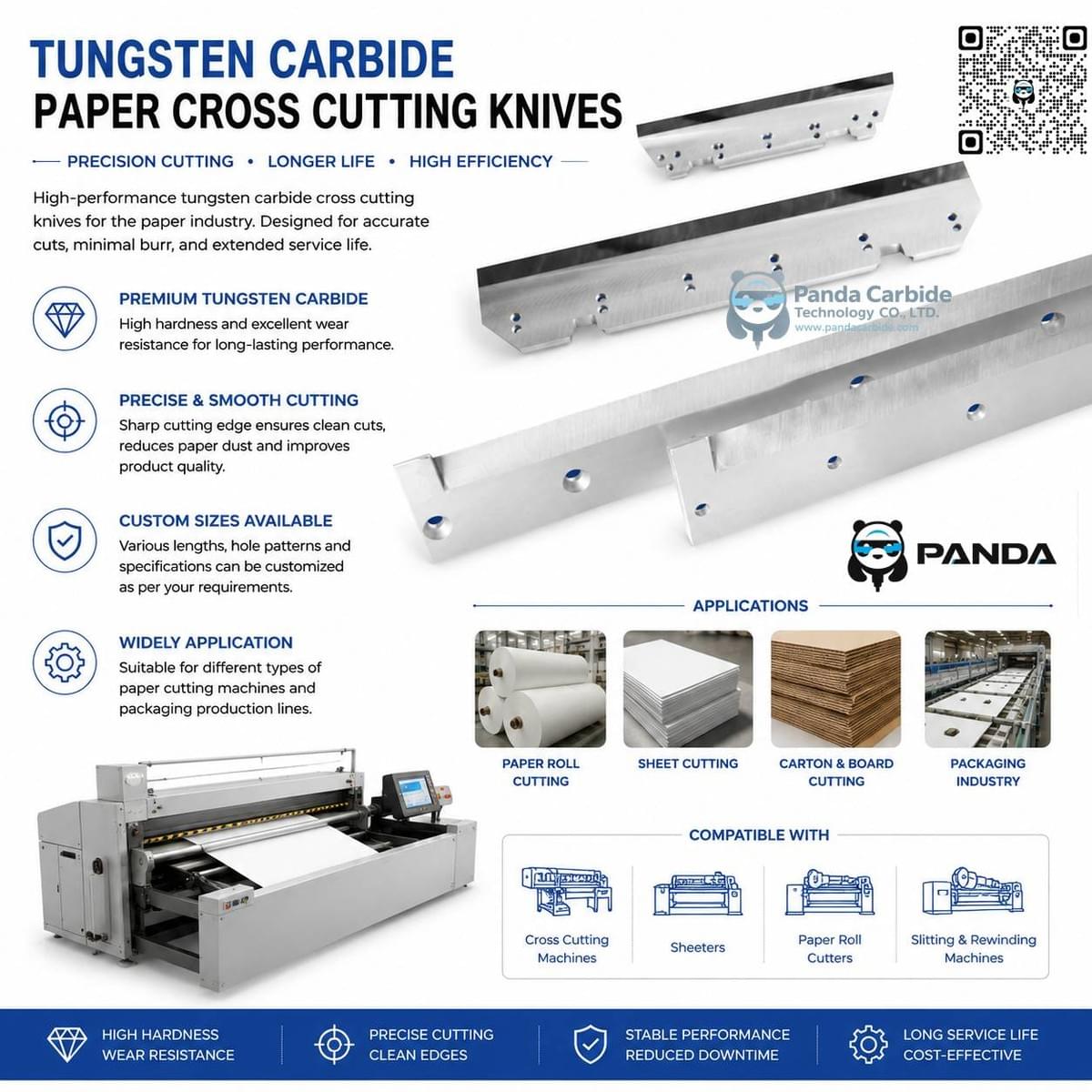
1. The Tri-Metal Brazing Barrier: Eradicating Carbide Delamination
Why do Panda Carbide’s inlaid crosscutting knives resist bonding separation and delamination under high-frequency impact cycles?
The core vulnerability of an inlaid industrial blade lies at the junction where the ultra-hard carbide insert meets the high-toughness tool steel backing. Because these two materials possess dramatically different thermal expansion coefficients, standard cooling generates massive residual shear stress across the seam, making it prone to fracture under high-speed dynamic loads.
Panda Carbide eliminates this bonding defect through a highly controlled manufacturing workflow:
- High-Strength Tri-Metal Silver Brazing: We utilize premium silver-based alloy brazing foils layered as a sandwich cushion between the carbide tip and the steel backing. This ductile silver matrix acts as a micro-mechanical shock absorber, accommodating the thermal expansion variance during cooling and cushioning dynamic loads during operation.
- Induction Thermal Containment: Heating is executed on digital induction systems that limit thermal cycles strictly to the bonding zone, protecting the metallurgical temper of the tool steel core.
- Overpressure HIP Sintering: The raw carbide insert itself is processed via Hot Isostatic Pressing (HIP) Sintering at TRS ≥ 2800 MPa , ensuring the keen cutting bevel has the microscopic density required to resist chipping when shearing heavy-gsm boards.
2. Mastering Straightness Across Extended Metric Scales
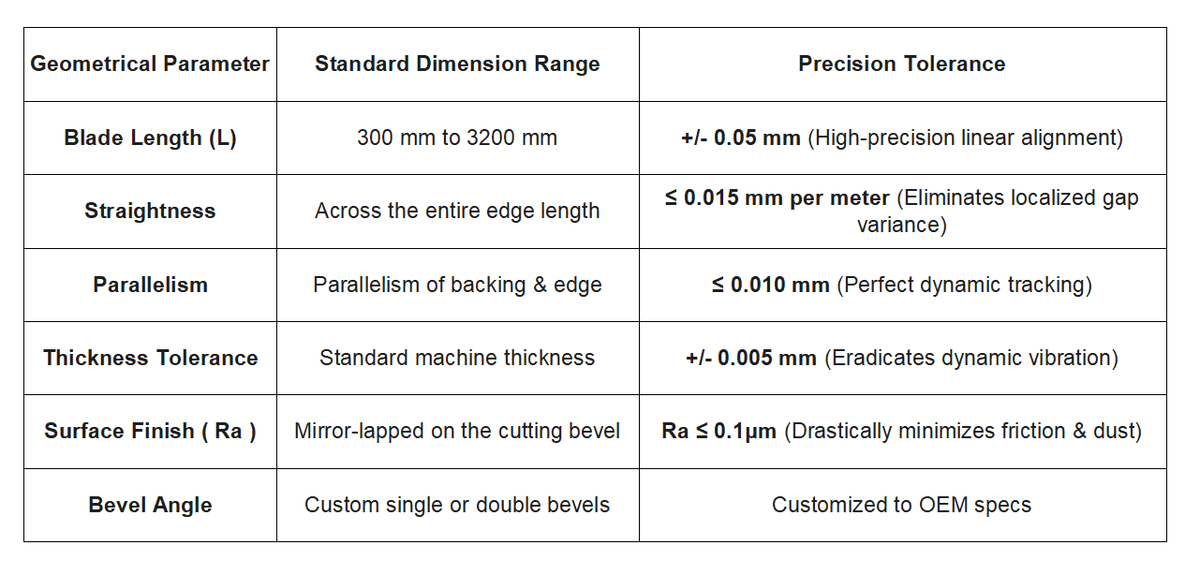
Achieving linear precision on sheeter blades measuring up to 3200 mm requires rigorous post-brazing stress management. If a long blade experiences even slight internal thermal warping, the shearing gap between the top and bottom rotary knives becomes uneven, resulting in poor cuts on one side of the web and high wear on the other.
Panda Carbide permanently ensures micro-level straightness through an integrated leveling process:
- Programmable Thermal Stress Relief: Post-brazing, all crosscut knives are placed in computerized cooling chambers that lower temperatures gradually over several hours. This process safely releases residual micro-stresses.
- Multi-Axis CNC Linear Grinding: Every blade flank and cutting bevel is ground under high-volume refrigerated oil streams, holding straightness strictly below ≤ 0.015 mm per meter. This uniform clearance prevents localized knife clash and extends the operating lifespan of the blade.
3. Technical FAQ: Material Lifespan and Converting Cost Efficiency
Q: What is the proven wear-resistance multiplier of an inlaid carbide sheeter blade compared to traditional HSS knives?
A: Modern commercial paper grades contain up to 30 % abrasive mineral coatings. Standard high-speed steel blades dull under this continuous friction, requiring manual knife adjustments or complete regrinding shutdowns every few days. Panda Carbide’s inlaid tungsten carbide edges maintain a high hardness of HRA 89.0 - 91.5. This uniform micro-density outlasts standard HSS tooling by 10 to 15 times. This structural longevity cuts machinery downtime, slashes knife-grinding budgets, and lowers the total finishing cost per ton by up to 40 %.
Q: What exact geometric features can be customized for large-scale global sheeter machinery?
A: Our production floor supports full mechanical customization based on your proprietary technical drawings. We match the specific configuration of integrated mounting slots, countersunk bolt positions, grease ports, and custom bevel profiles required for drop-in field installation.
4. Dynamic Web Synergy: High-Precision Industrial Portfolios
Our large-scale brazing expertise, sub-micron flatness controls, and micro-smooth bevel finishing drive our comprehensive line of automated web-finishing and packaging components:
- Internal Link: For operations running continuous dry-end sorting units, view our mirror-lapped [Ultra-Thin Tungsten Carbide Slitting Circular Knives].
- Internal Link: For packaging hubs requiring synchronized tooth-driven separation setups, explore our high-impact [Tungsten Carbide Slitting Saws for Paper Converting].
- External Link: [Consult the comprehensive international standards published by the International Organization for Standardization (ISO) regarding geometric product specifications (GPS) for straightness and parallelism tolerances in high-precision mechanical engineering applications.]
🏆 Elevate Conversion Uptime with Panda Carbide Technology
Upgrade your high-speed rotary sheeting performance with cutting tools engineered for high-impact durability and long-term dimensional stability. By pairing premium virgin metallurgy with advanced tri-metal silver brazing and precise CNC surface grinding, Panda Carbide Technology delivers crosscutting blades that eliminate delamination, minimize airborne paper dust, and keep your production lines running efficiently.
📩 Contact our B2B engineering desk today to submit your 2D/3D blueprint specifications (DWG, STEP, DXF) for a secure, rapid quote!
Panda Carbide - More Than Tough!
Rotary Crosscut Blades Specialist | Panda Carbide Technology CO., LTD.